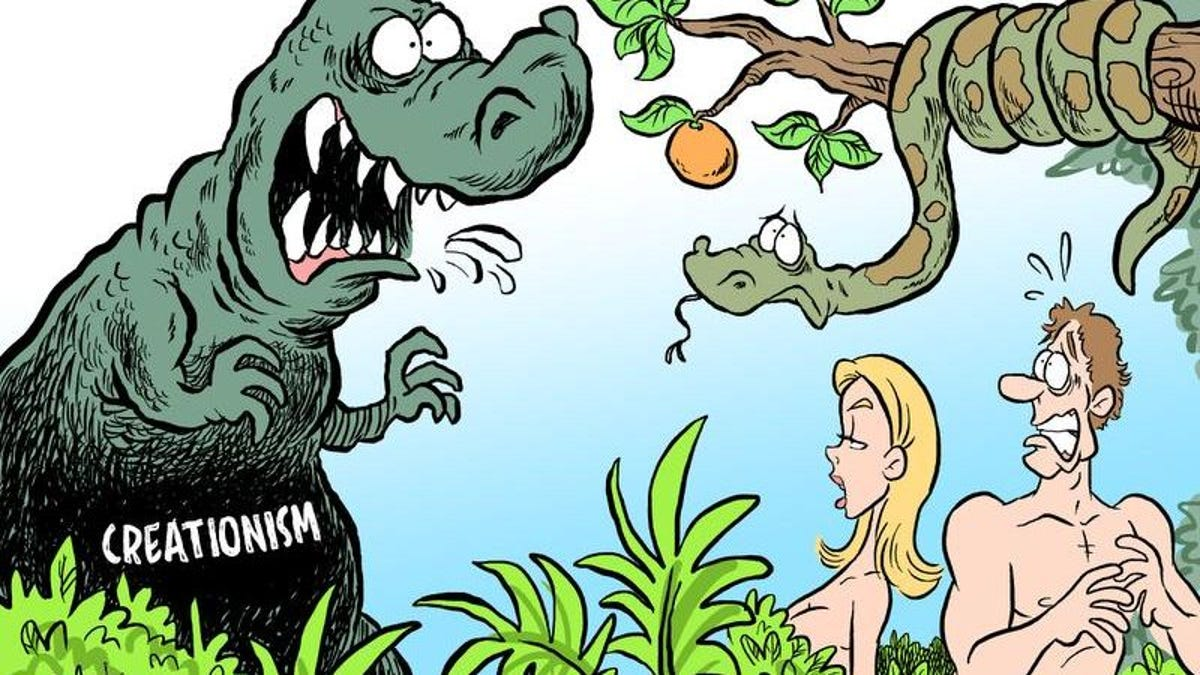
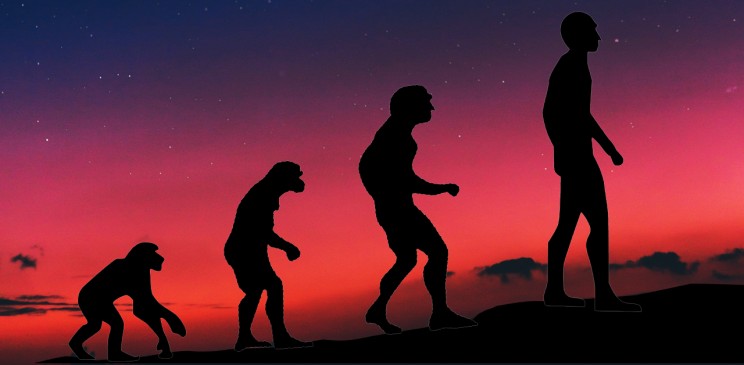
On reading Darwin’s evolutionary view in his On the Origin of Species, a contemporary was said to have responded that he hoped it were not true, and that if it were true, that it would not become widely known. True or not, the Darwinian view of the origin of everything by random change and natural selection has indeed become widely known. Surveys show however that at least among Americans, Darwinism may be more widely known than believed. A recent Gallup poll indicates that only 9% of Americans believe that man has evolved from simpler forms of life by a purely materialistic process extending over millions of years. In contrast, nearly half (47%) believe God created man in essentially his present form at one time within the last 10,000 years. A significant minority (38%) prefers a compromise view involving some form of divinely guided evolution. This latter view, variously called "progressive creation" or "theistic evolution," has become a hotly debated subject among Christians. The question arises – should Christians try to "make peace" with Darwin?
A revised version of this article was published in The Lutheran Witness, July, 1998, Vol. 117, No. 7
IS EVOLUTIONISM COMPATIBLE WITH SCRIPTURE?
Of primary concern to the Bible believing Christian is whether or not an evolutionary view of origins is compatible with God’s Word as revealed in Scripture. We may be confident that because God’s Word is truth, no observable fact of true science will be incompatible with it. On the other hand, the Bible tells us that some of the speculations and philosophies of men based on nature will be incompatible with God’s Word. Paul warns us in his letter to the Colossians, "beware lest anyone cheat you through philosophy and empty deceit, according to the tradition of men, according to the basic principles of the world, and not according to Christ (Col 2:8)." Whatever is eternal is God
The Bible speaks of a sovereign, omnipotent, and omniscient God who created out of nothing (ex nihilo) by the power of His Word. Thus God exists outside of nature (literally supernatural), and is the creator of all temporal things we call nature. God Himself, however, is not a created being but rather is uniquely eternal.
It has been said that whatever we hold to be eternal is our god. Those who deny the existence of an eternal God must ultimately declare nature itself to be eternal and thus, in effect, nature becomes their god. The philosophy that recognizes only the natural world as "real" is called naturalism
Foundational importance of Creation to the Gospel
Christians should be particularly careful how they view Divine Creation because it is foundational to the whole Bible and Christianity. Creation is given a preeminent position in the first chapter of the Bible and is the first Article of belief in the Apostles Creed (I believe in God the Father almighty, maker of heaven and earth). Throughout Scripture, the God who is real is contrasted with man’s false gods by virtue of God’s sovereign role as Creator.
Most importantly, there is an integral relationship between Creation and our Salvation. The first three pages of the Bible reveal both man’s accountability to God through his Creation, and man’s subsequent fall into sin and death through his disobedience. All the remaining pages (about 1,500 in a typical Bible) deal directly or indirectly with God’s solution to man’s sin problem documented in the first three pages. It should come as no surprise then that those who deny human sin and accountability would also seek to deny God as their sovereign Creator. Sadly, like Adam and Eve, they try to hide from the very God who could save them.
Is how God created really important?
Still, some Christians have argued that how God created is not that important as long as we credit God with at least some nonspecific role in the process. They insist that the Bible merely tells us who created while science (Darwinism) tells us how. After all, they ask, couldn’t God have used the process of evolution to create? Even some atheists have piously insisted that we dare not deny that God used the evolutionary process to create lest we "limit" His power and glory! But "Divine Darwinism" inevitably leads to either espousing evolution with miracles or creation without miracles. As we shall see, the former is incompatible with Darwinism while the latter is incompatible with Scripture.
It should be noted that Darwin himself was not a proponent of "Divine Darwinism." This is significant because Darwin studied to be an Anglican clergyman at Cambridge University and his only earned degree was in theology. While Darwin claimed to have initially accepted the beliefs of the Anglican Church of his day, he eventually came to deny the very existence of God and human immortality. In his autobiography, Darwin confessed that his growing evolutionary views gradually led him to unbelief. In the end he considered the Old Testament to be a "manifestly false history of the world" and as for the New Testament, he said he "could hardly see how anyone ought to wish Christianity to be true." Sadly, the widespread rumors of his deathbed repudiation of evolutionism and return to Christianity have not been substantiated.
Evolutionists don’t want Divine help
Just one of the problems with suggesting any sort of Divine help for the evolutionary process is that most evolutionists neither want it nor accept it. The reason for this is that the single most important attribute of evolution is that it claims to be a purely "scientific" explanation of origins. Today, the word "scientific" has come to mean naturalistic. It is now considered axiomatic that since science can only deal with the material world (not the supernatural), the material world must be all there really is. According to this illogical conclusion, science deals with the material world of reality, while religion deals with the immaterial world of unreality.
Evolution will have no other gods before it
It is often said that science (i.e. evolutionism) and religion are compatible as long as each is confined to its own proper realm. However, before Christians attempt to make peace with Darwin, they should be warned that evolutionism is itself a jealous "god" who will have no other gods before it. The famous evolutionist Julian Huxley declared that the "whole of reality is evolution, a single process of self transformation." How then can something that claims to be nothing less than the whole of reality be limited? This "whole of reality" view of natural science is not really science at all but rather a naturalistic philosophy called scientism.
Scientism regards virtually nothing that is real to be outside the realm of scientific analysis and evolutionary causation. Religion itself is considered to be merely a relatively recent product in the evolution of the hominid brain. In a meeting at Massachusetts Institute of Technology in 1981 (sponsored by the World Council of Churches!), scientists and theologians discussed their vision of a new faith enlightened by scientism rather than revelation. All considered religion to be a natural phenomenon. One scientist even claimed to have located the anatomical source of the "religious experience" in the parietal-occipital region on the right side of the brain. Not to be outdone by the scientists, a theologian proposed that the revitalization of religion would come from an "especially rich source – modern evolutionary theory."
Gods who don’t do anything
While a growing number of popular evolutionists such as Steven J. Gould, Richard Dawkins, and Carl Sagan have insisted that science (evolutionary scientism) and religion (Biblical Christianity) are incompatible, most are more circumspect lest the public become aroused. The preferred spin is to give guarded approval to those "proper religions" that are considered compatible with evolution even by their own adherents. Sadly, there is no shortage of theologians in any of the major Christian denominations willing to champion evolutionism, no matter what violence it may do to the Word.
But what sort of religion is likely to meet the approval of professional evolutionists? The answer is really quite simple -- you may worship god (or the gods) if you really must, but you may not claim that your god physically does anything. You must not claim, for example, that your god literally created things, or caused a worldwide flood or physically answers prayer. The Scriptures do in fact speak of such gods who are worshiped but can’t physically do anything – they are called idols.
SCIENCE AND THE QUESTION OF ORIGINS
How many different explanations for origins are there?
There are only two fundamentally different explanations for the origin of any complex structure. Either it owes its ultimate origin to chance and the intrinsic properties of nature, or to intelligent design imposed on nature. Thus the print (and message) you see on this page must ultimately be the result of either the intrinsic properties of ink and paper, or the extrinsic design of an author and publisher imposed on ink and paper. The essential difference between chance and design is that only the latter involves purposeful intent.
When it comes to the ultimate origin of nature and living things, most contemporary scientists insist that we must ignore even the possibility of intelligent design and confine ourselves to a purely naturalistic explanation. To the consistent evolutionist, none of the obvious complexities of living things can be considered as evidence for purpose or design. In his popular book, The Blind Watchmaker, evolutionist Richard Dawkins insists that blind chance merely counterfeits the appearance of intelligent design in nature.
The denial of the manifest evidence of the handiwork of God in nature is in direct contradiction to the Biblical claim that nature reveals the Glory of God. The Scriptures say that God’s "invisible attributes are clearly seen, being understood by the things that are made, even His eternal power and Godhead (Rom 1:20)." Indeed, Paul tells us in his letter to the Romans that this visible evidence for God’s eternal power and majesty in nature is so obvious that man can only deny it by "suppressing the truth" and in so doing is left "without excuse."
Are purely naturalistic explanations an essential requirement of science?
Many Christians accept the view that science must never appeal to the supernatural to explain natural phenomena. This axiom, called methodological naturalism, seems reasonable if we are speaking of ongoing phenomena that are subject to study by empirical science. Certainly, a scientist can understand something of the structure and function of the eye in purely physical-chemical terms without considering metaphysical or supernatural principles. The eye, like a camera, appears to be an optical device (though a profoundly complex one) that obeys the fundamental laws and physical properties of nature. However, if existing biological systems, like existing man-made machines, can be understood in mechanistic terms, it does not necessarily follow that the origin of these systems can also be understood in this way. How, for example, would one explain the origin of a modern automatic camera in purely naturalistic terms? Nothing we know about the physical composition of a camera could cause its spontaneous self-assembly with time. Sophisticated cameras come into existence only when intelligent designers and builders impose their design and work on the raw material from which the camera is made. Surely we can assume no less for a vastly more complex optical device such as the eye.
It is further argued that science must never consider the supernatural (even for origins) because to do so suppresses further inquiry and is thus fatal to the advancement of science. Some evolutionists go so far as to insist that Biblical Christianity (and particularly the doctrine of creation) would, if widely accepted, mean the end of all modern science and its benefits. This serious accusation bears our further investigation.
What is true science
We need only think about the horror of undergoing surgery without either anesthesia or antiseptics to appreciate the great gift that God has given us in our ability to understand nature through science. When God granted King Solomon unparalleled wisdom for the benefit of his subjects, this included a scientific knowledge of nature (1 Kings 4:33). It should come as no surprise then that God fearing people have historically made many of the most important discoveries in science (including the discovery of anesthesia and antiseptics). Indeed, science has both flourished and been sustained mainly in those societies which have a Judeo-Christian foundation.
It has been said that the reason science has flourished among God fearing people is that they expect a world designed by an all wise Creator to be a logical one, subject to rational understanding. A pagan view of the world, on the other hand, often sees nature as being capricious. Let us not then take an understandable world for granted. Albert Einstein said one thing not easily understood about the universe is that it is understandable.
Empirical science and the scientific method
In its broadest definition, the word science merely means knowledge or experience. But when most of us think of the wonderful achievements of science, we are generally thinking of a particular type of science known as empirical science. Empirical science is the study of nature by means of the scientific method. Powerful though it may be, empirical science does have three important requirements that limit the type of questions it is best suited to answer.
First, empirical science must deal with objects or phenomena that are observable. A second requirement is that the phenomenon under study must be repeatable so that it may be reexamined under controlled conditions. A third requirement is that any hypothesis we might propose to explain a phenomenon must be testable by some critical experiment capable of disproving it (in the event our hypothesis were false). Hypotheses that have repeatedly withstood tests that could disprove them are called theories.
How do evolution and creation measure up as empirical science?
Because of its limitations, the scientific method is best suited to studying structures and ongoing phenomena as they now exist. Thus empirical science can tell us much about how our existing eyes work but it is severely limited in telling us how we came to have eyes in the first place. Eyes, after all, are neither being created nor are they evolving into existence in the time frame of human observers. Thus, our attempts to explain origins are not technically scientific theories at all.
Even if we can’t explain the origin of the complexities of nature by the scientific method, we can investigate whether what we do know about nature is more consistent with an origin by chance (evolution) or by design (Creation). The Bible believing Christian will have the great advantage of examining his knowledge of nature in the light of the revealed Word of One who was actually there at the time of Creation. God’s Word is true and vastly more reliable than any human eyewitness account could be.
WHAT IS THE SCIENTIFIC EVIDENCE FOR EVOLUTION?
What exactly is evolution?
Evolutionists have found it difficult to agree on a definition of evolution. One of the problems is that evolution purports to explain the origin of virtually every thing that exists by a purely naturalistic mechanism of self-transformation. But how can the origin of the earth and heavenly bodies from simple matter, the origin of life from non-life, and the origin of all living organisms one from another, be explained by a single grand evolutionary mechanism? In an effort to make one size fit all, and yet sound plausible, some have insisted that evolution merely means "change" -- but this definition is too trivial to be useful. Still, the only concepts fundamental to all evolutionary "explanations" are random change and chance survival.
The origin of life
Darwin assumed that life itself evolved by chance from simple chemicals in some "warm little pond," but was unable to provide any specifics. To this day, an evolutionary explanation for the origin of life has proven to be so elusive to rational speculation that many evolutionists now insist it is not even a part of the theory of evolution. The well known evolutionist Sir Fred Hoyle has concluded that the formation of a living organism by chance would be comparable to "the chance that 'a tornado sweeping through a junk-yard might assemble a Boeing 747 from the materials therein." Nobel laureate Dr. Francis Crick (co-discoverer of DNA), in his book Life Itself, conceded that the improbability of life’s chance origin simply defies calculation. Crick, an atheist, said, "an honest man, armed with all the knowledge available to us now, could only state that in some sense, the origin of life appears at the moment to be almost a miracle."
Classical Darwinism
Wisely skipping over the most difficult step in evolution, the origin of life, Darwin was primarily interested in how the various plant and animal species came into existence. Darwin proposed four postulates that still comprise the central dogma of evolutionism. First, he proposed that the variation he observed among the individuals of a species was unlimited. Second, Darwin proposed that more animals of a species are born than can possibly survive given limited resources and that this results in a struggle for survival. Thirdly, he proposed that only those animals survive who happen by chance to be the most fit – a process called "natural selection." Finally, he proposed that those organisms that acquire characteristics which permit them to survive in their struggle with the less fit, would pass these characters on to their offspring.
The classical Darwinian view of natural selection as "survival of the fittest" eventually came to be recognized as a tautology and was later redefined as "differential reproduction." This interpretation of natural selection first became popular in the 1950's under the name of neodarwinism. In the neodarwinian view, natural selection does not merely select for animals that survive, but for animals that leave the most offspring.
Variation
Darwin's only observable evidence for "evolution in action" was the great
variation that occurs among the individuals of a species. Darwin was especially impressed
by the seemingly endless range of variation produced by animals under domestication such as
pigeons and dogs. He reasoned that if breeders could produce such a range of variation by
selecting for desired traits, nature in time could accomplish even more through "natural
selection." Darwin, who knew nothing of genetics, erroneously assumed that there was
virtually no limit to this variation among the individuals of a species.
Today, evolutionists like to refer to the sort of variation we see among
individuals of a species as microevolution, implying that this is somehow related to
the chance formation of fundamentally new animals by a process known as macroevolution.
Most evolutionists, however, concede that there is no known relationship between so-called
microevolution and macroevolution. Even so, most biology textbooks continue to extrapolate
the observable but limited variation among the individuals of a species into the unobservable
evolution of fundamentally new animals.
One of the great discoveries of modern science is how it is possible for animals of the same species to show limited variation without permanently changing into fundamentally different kinds of animals. Genetic analysis reveals that the individuals of a species do not share an identical set of genes (unless they are a clone), but rather have a small number of alternative versions of many genes called alleles. The fact that each individual inherits allelic versions of genes from both parents insures that no two individuals will ever be exactly alike. Collectively, the individuals of a species comprise a gene pool from which selection (either artificial or natural) can select. The important point is that we cannot select for genes that are not in the gene pool of the species.
Consider the remarkable species Canis familiaris, which includes the nearly 150 varieties of dogs recognized by the American Kennel Club. It is amazing that animals as different as a 125-pound St. Bernard and a 3-pound Chihuahua are at least potentially able to interbreed and are members of the same species! Still, there are limits to what can be achieved by even dog breeders. They can breed for long legs and short legs (within limits), but they cannot breed for flying dogs with wings. The reason for this is that there are no genes in the gene pool of the species Canis familiaris that could produce wings or any of the other countless modifications necessary for flight. For this, the evolutionist must look in vain to mutations.
Mutations
The marvelous ability of all living things to reproduce themselves after their kind is one of the most distinctive properties of life. This reproductive ability depends in part on a vast collection of precise genetic instructions called genes that reside in every cell of each living organism. It is believed that these genes provide encoded instructions necessary for not only the assembly and function of each cell, but also for all the proteins, tissues and organs of the entire body! A complete set of these genes (about 100,000 in humans) is stored in the chromosomes, inside the nucleus of each of the 30 trillion cells that make up our body.
The survival of every living species depends on its ability to pass on its precious genetic instructions, from cell to cell and generation to generation, without significant alteration. It is no more likely that the cells of our body might benefit from random changes in their genetic information than our television sets might benefit from random changes in their circuitry. If a species is to survive, its genetic information must be both duplicated and maintained with great precision. Toward this end, living cells have several error-checking mechanisms that help to ensure the accuracy of their gene duplication. Even so, genetic errors still can still occur in cells whether they are dividing or not. We call the random errors that creep into the genetic instructions of a cell, mutations.
Mutations are caused by certain kinds of chemicals, viruses and radiations. Ultra violet light from the sun, for example, can cause mutations in our skin, resulting in skin cancer. Cancer is so closely associated with mutations that the terms carcinogenic (cancer causing) and mutagenic (mutation causing) are essentially synonymous. None the less, evolutionists insist that some mutations are beneficial and lead to the gradual improvement of a species.
Although some mutations have no noticeable effect, many are harmful and even fatal. Mutations are so harmful that the very survival of virtually all living organisms (from bacteria to man) depends on a complex biochemical mechanism in each cell that identifies mutations as they occur -- and repairs them! This marvelous mutation repair mechanism involves an integrated sequence of special enzymes that actually cut out the erroneous (mutant) parts of each gene, and then splice in correct patches. A mutation in the mutation repair system itself is typically fatal.
Regrettably, some mutations manage to escape the repair process, and these accumulate throughout life. Some scientists have proposed that aging and death are the result of such unrepaired mutations. Evolutionists, on the other hand, are pleased that not all random mutations are repaired because they consider mutations (and indeed death itself) essential for the chance evolution of all living organisms, including man.
While there are special classes of highly controlled "mutations" that appear to be useful and part of the normal operation of cells, there are very few examples of unquestionably beneficial random mutations. Ironically, the primary textbook example of a "good" mutation is one that causes the disease sickle-cell anemia. This mutation of blood hemoglobin is considered "good" because people who have it (and survive it!) are more resistant to malaria. The symptoms of this "good" mutation include acute attacks of abdominal and joint pain, ulcers on the legs, defective red blood cells, and severe anemia often leading to death. One can only imagine what the bad mutations are like!
Evolutionists admit that mutations arising both in the laboratory and in natural populations typically produce deterioration, disease, and monstrosities yet their faith in random mutation, as the ultimate source of all genetic information remains undiminished. As the evolutionist Dobzhansky put it in his book Mankind Evolving , "This is not inconsistent with the recognition that useful mutations did occur in the evolutionary line that produced man, for otherwise obviously, mankind would not be here." Think about it, chance mutations or intelligent design, -- which explanation of the origin of the incredible complexity of life requires the greater faith?
Homology
Perhaps the most frequently used argument for evolution is the underlying fundamental similarity of all living organisms (especially in their genetic mechanisms) and our ability to arrange them in groups based on their degree of similarity. All vertebrates with legs, for example, have essentially the same suite of bones with each modified to best meet the needs of the species. Evolutionists argue that this is compelling evidence that all animals share a common ancestry from which they have evolved with modification. Creationists, on the other hand, argue that these great underlying themes among living things give evidence of a common Creator.
The fossil record
Since evolution is believed to occur far too slowly to be discernible in the time frame of human observers, fossils must be used to provide the historical evidence whether life has in fact evolved from simple to more complex forms. Fossilization typically occurs when organisms (either living or dead) are deposited from water into sediment. In some instances, the sediment solidifies making a cast of the entombed organism while in others, the organic material of the organism itself is replaced by mineral to form a stony replica. Conditions must be perfect for fossilization to occur, which explains why there is so little evidence of fossils being formed today. Both the burial of the organism in sediment and its subsequent hardening must occur quickly lest the decay process destroy the organism before it is fossilized. Most fossils do indeed give evidence of quick and catastrophic burial. Evolutionists believe that fossilized organisms were gradually deposited in sequential layers of sediment over hundreds of millions of years. This they believe has produced a geologic column comprising many layers of sedimentary rock that give a visual record of at least some of the stages of evolution from the first simple organisms to the most complex. Most creationists, on the other hand, believe that nearly all fossils were deposited over a relatively short time during and after a worldwide Flood. Thus, creationists believe the fossil record reveals organisms that were mostly contemporary -- not an evolutionary sequence extending over millions of years. These beliefs are sufficiently different that it should be quite easy to determine which is more consistent with the fossil record as it exists today.
To be consistent with evolution, the fossil record should show how organisms slowly transformed one into another through countless intermediate or transitional stages. Evolutionists, for example, claim that it took over hundred million years for the gradual transformation of invertebrates into vertebrates. If this were true, we would expect that the fossil record should show at least some of the progressive stages of this large-scale transformation. To be consistent with creation, on the other hand, the fossil record should show no obvious transitional stages between distinctly different kinds of organisms, but rather each kind of organism should appear all at once and fully formed.
A growing number of evolutionists concede that the fossil record shows few if any unambiguous transitional stages in the evolution of an organism into a distinctly different kind of organism. The popular evolutionist Stephen J. Gould has called the extreme rarity of transitional forms in the fossil record "the trade secret of paleontology. " Evolutionists have been aware of these missing transitional forms since the time of Darwin, blaming it on the incompleteness of the fossil record. Some still cling to the hope that the "missing links" which they believe formed a continuous chain of evolution may yet be found. This seems unlikely, however, since most paleontologists believe that the majority (over a quarter million species) of all existing fossilized species of plants and animals have already been found and identified. Even most of the currently living kinds of plants and animals have been found in essentially their present form in the fossil record. David Raup, a paleontologist at the Field Museum of Natural History, has proposed that we may even have fewer examples of evolutionary transition today than we had in Darwin's time! This surprising conclusion is based on the fact that some of the classic examples of transitions, such as the evolution of the horse in North America, have had to be discarded or modified as a result of more detailed information.
Some evolutionists have argued that the absence of transitional forms is simply an "artifact" of classification. Others insist that the gaps occur only among the higher taxonomic groups, while still others insist that the gaps occur only among the lower taxonomic groups. In his book Biology and the Future of Man , evolutionist Philip Handler claimed that among the 25 major phyla recognized for all the animals, "in virtually not a single case is there fossil evidence to demonstrate what the common ancestry of any two phyla looked like." The evolutionist George Gaylord Simpson conceded in his book Major Features of Evolution that every paleontologist knows most new species, genera, and families, and nearly all categories above these levels "appear in the record suddenly and are not led up to by known, gradual, completely continuous transitional sequences." As for the lowest level of taxonomic classification, the popular evolutionist Steven J. Gould said that "in any local area, a species does not arise gradually by the steady transformation of its ancestors; it appears all at once and fully formed." This, of course, is exactly what creationists would expect to find.
While most evolutionists still insist that there are at least a few examples of transitional forms in the fossil record, some question whether the fossil record provides a single example of a major evolutionary transition. Some even doubt if ancestor/descendent relationships can be determined with fossils. None of this, however, has diminished the faith of the true believers in evolutionism. It has even been claimed that the lack of transitional stages actually tells us something interesting about evolution! In an effort to explain the missing links, evolutionists have turned to an old discredited idea called "punctuated equilibrium." According to this speculation, evolutionary changes occur as relatively quick bursts (i.e. are punctuated) separated by long periods of stasis and inactivity (i.e. equilibrium). In this view, animals would only tend to leave fossils after the actual evolutionary stages were complete. One of the early proponents of this theory speculated that once long ago a reptile laid and egg and a bird flew away! While this would certainly explain the lack of transitional forms in the fossil record, it does little for the credibility of evolutionism as a scientific explanation.
WHAT IS THE SCIENTIFIC EVIDENCE FOR CREATION?
Evolutionists often challenge Creationists to come up with their own scientific explanation for origins. The only explanation the evolutionist will accept, however, is a materialistic one. Since the act of Creation was clearly a miraculous event, there can be no materialistic explanation. Whether or not we find the evidence for Creation compelling depends on our willingness to accept the Biblical revelation of an omnipotent and omniscient God. As we have seen, many scientists have great difficulty accepting the idea that some things may not have a natural explanation. They do not seem to fear the unknown so much as the unknowable. This threatens the pride and sovereignty of natural man who from the time of the fall wishes to be as gods deciding for him self what is right and wrong.
Most of the scientific argument for Creation involves the overwhelming evidence for intelligent design in nature while demonstrating the utter failure of evolutionary explanations that appeal to chance. We usually have no trouble detecting evidence for intelligent design in a structure, even if we do not know its builder or purpose. Stonehenge, for example, is a prehistoric structure in England that consists of a large circular arrangement of huge stones whose relative positions seem to be related to the point of the midsummer sunrise. We do not know who built this majestic structure nor are we certain of its function but nobody doubts that it was designed and built by intelligent beings.
Intelligent design
The Bible reminds us of the obvious fact that an intelligent designer and builder is necessary for building anything that is complex, "for every house is built by someone, but He who built all things is God (Heb 3:4)." Modern biology has found living things to be far more complex than Darwin could have imagined in his day. The human brain, for example, consists of approximately 12 billion cells, forming 120 trillion interconnections. The light sensitive retina of the eye (which is really part of the brain) contains over 10 million photoreceptor cells. These cells capture the light pattern formed by the lens and convert it into complex electrical signals, which are processed and sent to a special area of the brain where they are transformed into the marvelous sensation we call vision.
The signal processing ability of the cells in the retina greatly exceed the computational power of our most sophisticated supercomputers. It has been estimated that in one hundredth of a second, the signal processing of a single photoreceptor cell from the retina requires the solution of approximately 500 simultaneous nonlinear differential equations 100 times! Considering that there are more than 10 million such cells interacting in complex ways in the retina, it would take nearly 100 years for our fastest supercomputer to simulate what takes place in our eye many times every second!
All life reproduces after its kind
The Bible tells us that following its original creation, each animal continued to reproduce after it’s kind (the Hebrew word for kind is min). "Let the earth bring forth the living creature according to its kind: cattle and creeping thing and beast of the earth, each according to its kind; and it was so" (Gen 1:24). This would seem to leave little room for evolution unless the Genesis kind might have represented a higher taxonomic group like perhaps a class or order. In an effort to accommodate at least some evolution in Creation it has been proposed that God might have created, for example, a single bird kind from which all the species of birds alive today have evolved. Levitical law, however, defines kind much more narrowly than this. A long list of birds including the falcon, raven, ostrich, short-eared owl, screech owl, white owl, carrion vulture, stork and heron are each described as being a kind (Lev. 11:14-19).
In his "table talks," Martin Luther spoke of the Greek scholar Cicero's proof for the existence of God. "The best argument that there is a God ¾ and it often moved me deeply ¾ is this one that he proves from generation of species; a cow always bears a cow, a horse always bears a horse, etc. No cow gives birth to a horse, no horse gives birth to a cow, no goldfinch produces a siskin. Therefore it is necessary to conclude that there is something that directs everything thus" (Luther’s Works, 1967 Fortress Press, p. 423).
Dating and the Appearance of Age
Even among those Christians who seem to agree that God created solely by the power of His Word there remains disagreement about the age of the earth and, by implication, the duration of the "six days" of Creation. Certainly if there were no compelling reasons to believe otherwise, the Bible clearly implies that the six days of creation were six ordinary days. While the Hebrew word for day (yom) can mean a long time, the intent of the author is generally evident in the text. Not only were the days of Creation numbered, as was customary for literal rather than figurative days, but each was described in the Hebrew manner for ordinary days as having an evening and a morning. The word yom appears in Scripture over 100 times in association with "evening and morning" and in every case, it clearly refers to an ordinary day. If the "days" of Creation in Genesis chapter one are not to be taken as ordinary days, it is difficult to imagine how the text would have to be written to convince the contemporary reader that they were ordinary days?
Some Christians are convinced that the scientific evidence for a 4.5 billion year old earth is so compelling that Scripture must be interpreted in the light of science no matter what the text may say. Space does not permit a critique of geological dating methods but it is hardly an exact science. Different methods often give different dates for the same rocks. Even different rocks from the same geological formation may give different dates. When "unacceptable" dates are encountered, Geologists often use their evolutionary assumptions about the presumed age of the fossils in the rock layers to date the rock. Since the rock layers in turn are used to date the fossils they contain, this is circular reasoning.
In any event, the Christian should be aware that while the earth may appear to be vastly older than a literal Biblical chronology would allow, it may still be much younger than it appears. Virtually everything that God created (including the wine for the wedding at Cana) must have had the appearance of age and ongoing process at the very moment of its creation. Adam and Eve, for example, were presumably created as sexually mature adults. If Eve had been created with hair as long as artists tend to portray it, it would have appeared to be the product of over ten years of hair growth. It would be ludicrous to think, however, that the omnipotent Creator, who was able to instantly create Eve by means of a miracle, would then be obliged to wait several years to "create" a head of hair by a natural process. Similarly, a Creator who can create the stars by the power of his Word would not then be obliged to wait billions of years for their light to reach the Earth to serve man as "signs and seasons."
THE IMPLICATIONS OF EVOLUTION
Evolution and death
The Scriptures tell us that "by sin, death came into the world" and that the "the wages of sin is death." Evolutionists, however, vigorously deny that sin has anything to do with death, but rather that death is natural. Life, they insist, would be impossible without death. Certainly, evolution would be impossible without death. Death, in fact, has been called the "engine" of evolution. The late Carl Sagan said, "only through the deaths of an immense number of slightly maladapted organisms are we, brains and all, here today." Evolutionism inevitably breaks the relationship between sin and death, thus negating the need for a Savior who would save us from sin, death and the power of the Devil.
Creation and the resurrection
Finally, when the Lord returns in Glory on the last day and the dead are raised from their graves, will scholars attempt one last naturalistic explanation for even this? Or will we all finally concede that God does miracles beyond our understanding? Will we finally be still before the throne of God and let God be God though every man be found a liar? We will indeed!
© 1997-2004 Missouri Association for Creation, Inc.
All Rights Reserved